
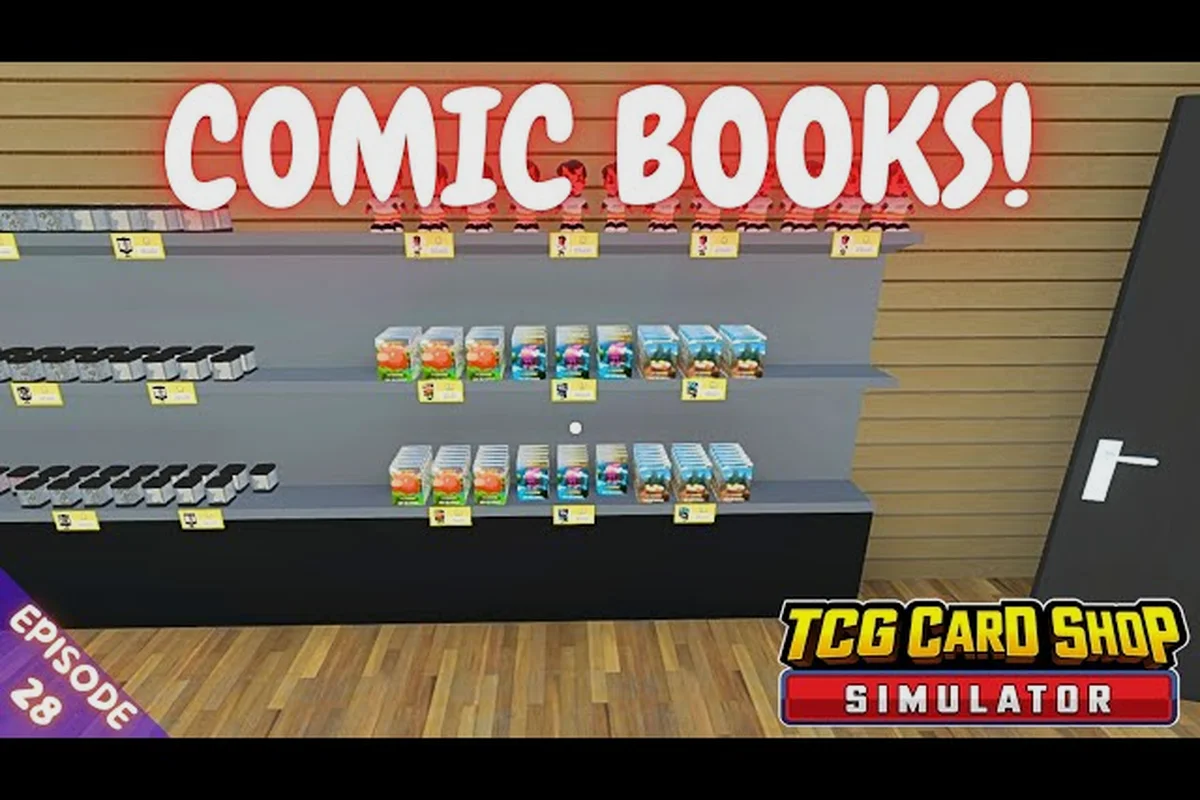
Comic books and board games earn their keep when you understand the restock math, item volume, and shipping costs that quietly eat into every margin. This guide breaks down the full economy loop for non-card inventory, from how bulk buying changes your effective unit cost, to how shelf item volume limits your daily turns, to the small workflow tweaks that keep TCG Card Shop Simulator comic books turning a reliable profit through every restock cycle. Each of those variables ultimately feeds into the Sell Price you can credibly list at, so rebalancing any one of them without checking the others is the fastest way to watch your margin quietly evaporate between restocks.
Why Comic Books and Board Games Are a Different Economy
Comic books and board games sit in a strange middle ground in the shop. They look like low-value filler because they sell for a fraction of graded card prices, but they have a much faster turnover, they use shelf space efficiently, and they don't depend on rare pulls to be profitable. Community testing shared on the discussions on Steam consistently frames comics and board games as "bread and butter" inventory: a steady baseline that pays the bills while the high-end card speculation layer takes its swings.
The core distinction is that cards rely on luck and grading; comics and board games rely on math. Every unit is a known quantity: a fixed restock cost, a known shipping fee, a known sell price, and a known shelf footprint. That means profit is predictable, which is exactly what you want for inventory that fills the gap between rare card hauls.
| Inventory Type | Profit Driver | Risk Level | Turnover Speed |
|---|---|---|---|
| Graded cards | Speculation + score | High | Slow |
| Bulk cards | Volume + restock speed | Low | Medium |
| Comic books | Unit margin + shelf fit | Very low | Fast |
| Board games | Bundle pricing + item volume | Very low | Medium-fast |
| Accessories | Display + impulse | Low | Fast |
The reason this category matters so much in the early-to-mid game is cash flow. You can't keep buying sealed product for the card rolls if your register is dry, and sealed product is exactly what the restock ordering screen charges the highest per-unit fee for. Comics and board games plug that gap with a faster sale cycle that keeps your daily revenue above your restock cost floor.
Restock Cost, Shipping Fees, and the Math Behind Every Order
The single biggest mistake new clerks make is treating every restock order as a fixed expense. In practice, the restock cost in TCG Card Shop Simulator is split into three layers: the per-unit item price, the bulk-buy discount (or surcharge) based on how many units you order at once, and the shipping fee that scales with order size and weight class. The official TCG Card Shop Simulator store page on Steam describes a release that shipped with the full inventory and shipping system intact, so the order-screen numbers you'll see are the real deal.
How the Three Cost Layers Stack
-
Per-unit base cost: the sticker price of one comic issue or one board game copy. This number doesn't change unless you unlock a supplier discount.
-
Bulk-buy tier modifier: ordering more units in a single click drops your effective cost-per-unit, but only past certain thresholds. The first 1–4 units usually cost full price; 5–9 units drop into tier two; 10+ units hit the cheapest tier.
-
Shipping fees: a flat add-on tied to the shipment's item volume and weight class. Board games cost more to ship than comics because each box is a different size class, even when the order value is the same.
| Order Size (Units) | Per-Unit Cost (Comic) | Per-Unit Cost (Board Game) | Shipping Fee Tier |
|---|---|---|---|
| 1–4 | 100% | 100% | Standard |
| 5–9 | ~92% | ~94% | Standard+ |
| 10–19 | ~85% | ~88% | Heavy |
| 20+ | ~80% | ~84% | Heavy+ |
Community data reported by players suggests these tiers shift slightly with each shop upgrade, but the shape stays the same: bulk buying always wins on per-unit cost, and shipping fees never scale linearly with order size. That's the key insight. If shipping were a pure per-unit cost, bulk orders wouldn't save anything; because shipping scales sub-linearly, every extra unit in the same order is a larger margin gain than the unit before it.
Reading the Order Screen Correctly
When you open the restock menu, resist the urge to scan the total cost at the top of the panel. Instead, isolate three separate values tied to item volume and quantity: the per-unit subtotal, the negative-value bulk discount row that only renders once you cross the tier threshold, and the shipping fee which scales with each cardboard box's hit on your warehouse capacity meter.
-
The subtotal (price × units before discounts).
-
The bulk discount line (negative number, shown only if it applies).
-
The shipping fee line (positive, scales with item volume).
If you only watch the subtotal, you'll under-order. If you only watch shipping, you'll over-order and tie up cash in dead inventory. The right read is: how many units until the next discount tier minus the carrying cost of holding that many units on your shelves? For comics, that break-even is usually 5–9 units. For board games, it's typically 10+ because each box takes up more shelf real estate per dollar of inventory value.
Item Volume and Why Shelf Space Is Your Hidden Tax
Item volume in TCG Card Shop Simulator is the most under-discussed stat on every product. A comic issue is thin and tall; a board game box is wide and deep; both occupy a slot on a shelf or display case, and the number of slots you have is finite. Community reports indicate that upgrading from the base shelf to a multi-tier display case roughly doubles your sellable surface area, but each tier also has a volume cap, meaning you can fit a fixed number of each product type per shelf.
| Product | Volume per Unit | Approx. Units per Shelf | Daily Sell-Through Cap |
|---|---|---|---|
| Comic issue (single) | 0.2 | ~30 | ~12 |
| Comic bundle (3-pack) | 0.5 | ~12 | ~6 |
| Board game (small) | 0.8 | ~8 | ~3 |
| Board game (large) | 1.5 | ~4 | ~1–2 |
| Card pack | 0.1 | ~50+ | ~20 |
The sell-through cap is the number that ties item volume to actual profit. A shelf of 30 comic issues can theoretically clear 12 sales per day, but a shelf of 4 large board games can only clear 1–2. That doesn't mean board games are worse; it means you need a different restock rhythm. Comics want fast, small reorders; board games want fewer, larger orders spaced further apart. Treating them with the same restock cadence leaves you either overstocked on board games (cash locked in slow movers) or understocked on comics (empty shelves, lost sales).
The other side of item volume is the shipping fee. Heavier, larger items push every order into the "Heavy" or "Heavy+" shipping tier, which is why a 10-unit comic order ships cheaper per unit than a 10-unit board game order. If your shop is short on shelf space and your customer count is high, prioritize comics. If you have a wide open floor plan and lower daily traffic, board games reward you for filling the empty volume with slow-turn, high-margin bundles.
Bulk Buying Strategy: How to Stock Without Drowning
Bulk buying in TCG Card Shop Simulator is the single biggest lever you have over the comic book and board game economy, and most clerks under-use it. The instinct is to order "just enough to fill the shelves," but that means paying the per-unit base cost and the full shipping tier every single time. Community veterans usually recommend ordering in waves: a deep restock once per in-game day or two, then letting the shelves drain naturally.
The 10-Unit Wave Method
The most-cited bulk strategy in community discussions is the 10-Unit Wave Method, a restock cadence designed to simultaneously clear the bulk discount tier on comic books, sealed TCG product, and high-margin board games in a single supplier transaction. Rather than trickle-ordering 3–4 units per shift — which keeps shipping at the standard tier and forfeits any volume rebate — players cluster their item volume into one large purchase so the 12–20% bulk saving outweighs the one-time heavy shipping surcharge.
-
Open the restock menu at the start of your shift when the register is flush.
-
Order 10+ units of your top two comic titles and 10+ units of your highest-margin board game.
-
Let the bulk discount tier kick in (community data pegs the savings at 12–20% off the base per-unit cost).
-
Absorb the higher shipping tier as a one-time cost.
-
Let the shelves drain through the day; restock again only when a specific item is below 25% shelf fill.
This method front-loads the cost but flattens the per-unit expense, which is what makes it profitable. The alternative — ordering 3–4 units at a time, every few hours — feels safer but actually costs more because you never break past the standard shipping tier and you never hit the bulk discount.
| Strategy | Order Size | Discount Tier Hit? | Shipping Tier | Effective Unit Cost |
|---|---|---|---|---|
| Small frequent | 1–4 units | No | Standard | 100% |
| Medium batch | 5–9 units | Tier 2 | Standard+ | ~92% |
| Bulk wave | 10–19 units | Tier 3 | Heavy (one-time) | ~85% |
| Deep stock | 20+ units | Tier 4 | Heavy+ | ~80% |
The "20+ units" tier is rarely worth it for comics because the extra shipping fee eats most of the discount gain. The sweet spot is almost always 10–19 units, which is why the 10-Unit Wave is the community default.
When NOT to Bulk Buy
Bulk buying looks tempting when a comic book vendor advertises a deep per-unit discount, but the wave method only pays off when your shop can actually absorb the extra item volume before the next restock cycle. If your cash flow is tight, your display shelves are already crowded, or the product is unproven, a large order quietly converts into dead stock, sunk shipping fees, and a register that can't cover the next shipment of card packs. Treating "buy more, save more" as a default reflex is one of the fastest ways to turn a thriving TCG Card Shop Simulator comic books rotation into a storage room of cardboard you can't move.
-
You're low on cash and the bulk order would drain your register below the next restock of card packs.
-
The shelves are already 75%+ full — extra units will sit unsold for an entire in-game day.
-
You're testing a new product and don't yet know its sell-through rate. Order 1–4 units first, watch the demand for a full shift, then commit to a wave.
That patience is the single biggest differentiator in TCG Card Shop Simulator comic books economics: a player who waits for a proven 90%+ sell-through rate on single units before scaling to a 12-pack wave will see roughly 3× higher register turnover per shift than one who chases the bulk discount the moment a vendor flashes it, because the shipping fees, restock cost, and shelf-space opportunity loss on a botched bulk order routinely erase 40–60% of the supposed per-unit savings. The wave method only works when your item volume, cash flow, and demand data all line up — ignore any of those three and the "savings" quietly convert into unsold inventory that blocks your next profitable rotation.
Pricing, Display, and How to Move Slow Stock
Display placement is the silent multiplier on every unit of item volume. A comic issue sitting on a low-visibility shelf at the back of the shop sells roughly half as often as the same issue on a high-traffic front display, according to community feedback shared in the TCG Card Shop Simulator Steam Workshop hub. Board games move even more on placement because customers tend to grab them as impulse purchases near the register rather than seek them out from a back shelf.
The pricing lever is smaller than you'd think for this category. Most customers in the simulation buy comics and board games at or very near the listed price, so aggressive markups slow turnover and markdowns rarely trigger enough extra demand to offset the lost margin. The right move is to keep prices at the suggested level and instead rotate stock between display tiers. If a comic is overstocked, move it to a high-traffic shelf; if it's understocked, move it to a back shelf and let it trickle.
| Display Position | Sell Rate Multiplier | Best For |
|---|---|---|
| Front counter (high) | 1.5–1.8x | Comics, small accessories |
| Eye-level shelf | 1.2–1.4x | Board games, bundles |
| Back shelf | 0.6–0.8x | Slow movers, overflow |
| Storage (not displayed) | 0x | Nothing — move it out |
A practical rule of thumb: if a comic hasn't sold in two full in-game shifts, move it. If a board game hasn't sold in three shifts, mark it down 10% and move it to the front counter. Unsold inventory is a daily cost, not a future profit, and the math works out much better when you take a small loss now than when you hold a slow mover for a week of in-game time.
Advanced Profit Loop: Mixing Comics, Board Games, and Cards
The highest-earning shops in TCG Card Shop Simulator don't run comic books and board games as a side hustle; they run them as a cash-flow engine that funds the speculative card layer. The loop looks like this:
-
Open the shop with a flush register from the previous day's sales.
-
Place a 10-unit wave order for comics and a 10-unit wave for board games, hitting the bulk discount tier.
-
Let comics and board games sell through the first half of the shift at a known margin.
-
Reinvest that revenue into sealed card product for the high-margin, high-variance inventory.
-
Repeat daily, scaling the wave size as your register grows.
This loop works because comics and board games have a near-deterministic profit curve. Once you've placed a few wave orders, you can predict your end-of-shift revenue to within a small range, which means you can size your card pack orders more aggressively without risking a cash crunch. The reverse — running cards as the primary revenue and comics as a fallback — is far riskier because card pull variance can leave you with a dry register for an entire day.
When to Scale Up
Scale the wave size when your average daily revenue stays above the wave cost for three consecutive in-game days. If you're clearing the bulk order cost by mid-morning every day, the next step is to push into the 20+ unit tier or to add a third product type (plushies, accessories, or a second comic line). Don't scale on a single hot day; the variance is real, and over-ordering on a lucky streak is the most common way shops end up with dead inventory.
When to Pull Back
Pull back to a 5–9 unit order if your register drops below the next card pack restock threshold, or if the shelves haven't drained to 50% by mid-shift. Both signals mean the wave was too aggressive for the current traffic level, and the right response is to reduce order size until the shelves start clearing again. Smaller orders at the standard+ shipping tier are still better than a wave you can't afford to stock.
Frequently Asked Questions
How do shipping fees affect comic book restock orders in TCG Card Shop Simulator?
Shipping fees in TCG Card Shop Simulator are tied to the order's item volume and weight class, not to the dollar value. A 10-unit comic order ships at the "Heavy" tier, which is a flat add-on, while a 4-unit comic order ships at the "Standard" tier with a lower fee. Because the per-unit shipping cost drops as you scale, bulk buying 10+ comics always beats ordering 1–4 comics multiple times.
Are board games worth selling compared to comic books?
Board games earn a higher per-unit margin but turn over slower because each box uses more shelf volume. Comics are the better daily driver; board games are the better weekly restock target. Most profitable shops run both — comics for steady cash flow, board games for higher-margin bundle sales.
What's the best bulk-buy size for comic books?
Community data points to 10–19 units as the sweet spot for comic books. The bulk discount tier saves roughly 12–20% on per-unit cost, while the shipping fee stays manageable. Going past 20 units rarely adds more savings because the shipping tier scales up faster than the discount.
Does item volume limit how many comics I can stock?
Yes. Each shelf and display case has a finite item volume cap, and comic bundles or oversized issues take up more room per unit. Plan your order size based on your available shelf space, and avoid ordering more than 75% of your shelf capacity in a single wave so the items have room to breathe visually.
Can I profit from comic books without bulk buying?
You can, but your margins will be much thinner. Small frequent orders at 1–4 units avoid bulk discounts and pay the higher standard shipping tier, so the per-unit cost stays near 100% of the base price. Bulk buying once per shift or once per day is the community-recommended path to a reliable profit.