
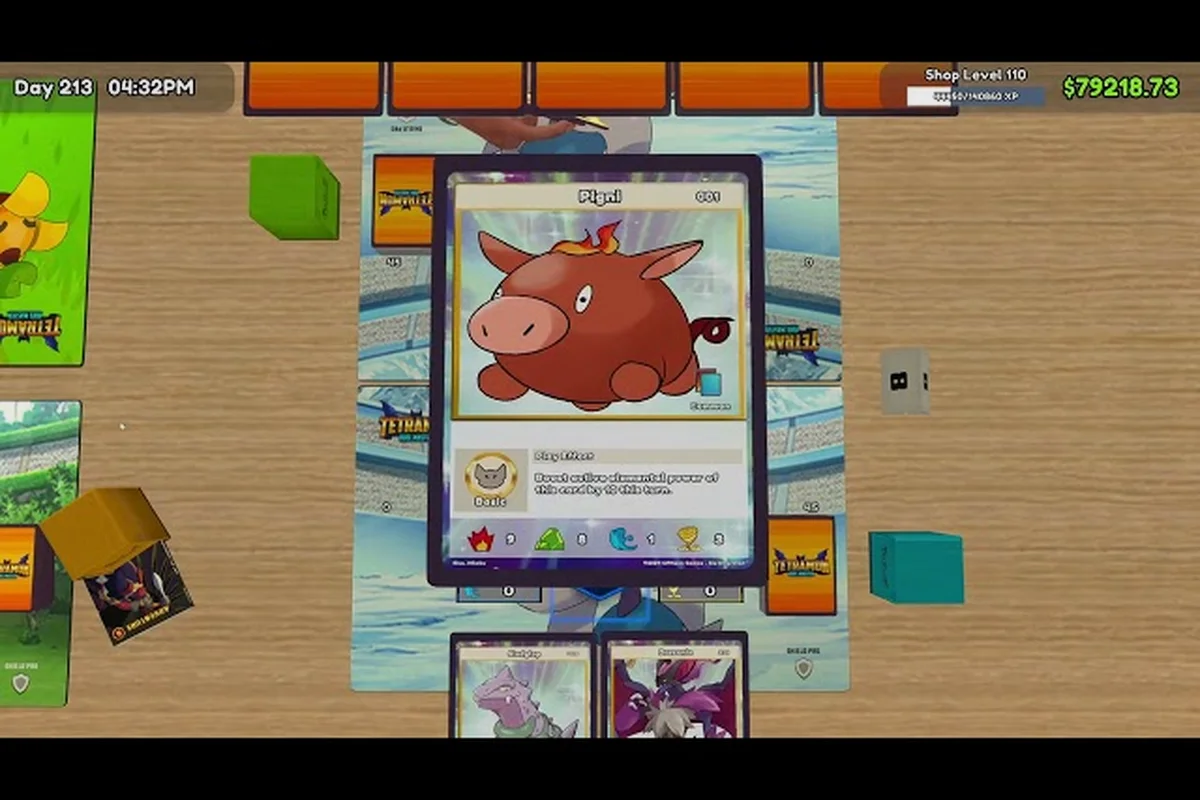
TCG Card Shop Simulator Match Rules Overview
Inside TCG Card Shop Simulator, the tabletop game played on the shop's play tables runs on a tight set of match rules that every shopkeeper who hosts tournaments needs to memorize. The in-game rulebook at the workbench lays out the turn structure, costs, and win conditions for the card game called Tetramon, and the 1.0 release tied tournament play directly to the retail side of the shop. According to the TCG Card Shop Simulator community guides hub on Steam, the printed cards you stock on your shelves are the same cards your customers duel with, which means learning the match rules is also a way to predict what inventory to buy.
The core loop of any duel looks like this: each player draws, plays Tetramon cards to the field, pays Energy to activate card effects, and attacks until one side runs out of cards. Damage calculation flows through a Type and Element system, and every match resolves around the Element Weakness Chart that decides how much damage each attack actually deals. Getting these numbers right is the difference between winning a Standard event and watching a customer walk out with a free pack.
This guide walks through the match rules the way the rulebook presents them, breaks down damage calculation step by step, and gives you the counter chart data you need to build a deck that does not fold the moment a Fire card meets an Earth deck. The information below reflects community testing reports gathered from the r/TCGCardShopSimulator subreddit and the official channel on YouTube, cross-referenced with what the in-game rulebook shows at the workbench.
How Turn Structure and Card Effects Work
Every Tetramon duel follows a strict turn order, and missing a step means losing tempo. The turn structure is the first thing printed on page one of the rulebook, and it sets the stage for every later match rules interaction.
Turn Order Phases
Each turn has five sequential phases, played in strict order by the active player only — opponents cannot interrupt, respond, or activate effects during phase transitions until the phase itself officially resolves. This rigid turn structure mirrors classic dueling formats and ensures the Draw Phase, Energy Phase, Main Phase, Battle Phase, and End Phase resolve predictably, which is critical for timing chain reactions on Trainer cards and correctly applying the element weakness system.
-
Draw Phase — draw one card from your deck of 20 cards. If your deck is empty at the start of your Draw Phase, you lose the duel.
-
Energy Phase — gain one Energy counter, capping at ten. Energy resets to zero on your first turn.
-
Main Phase — play Tetramon cards from your hand, attach Energy cards to your active Tetramon, and activate Trainer or Item card effects.
-
Battle Phase — declare attacks with Tetramon that have been on the field for at least one full turn (the First Turn Rule blocks immediate attacks).
-
End Phase — discard down to a hand size of seven if you have more cards than that, and pass the turn.
A turn where you skip the Battle Phase to set up your board is called a Set Turn, and players who can read the match flow know when to take one. According to community data posted in the r/TCGCardShopSimulator subreddit, the average tournament match lasts 7 to 9 turns, so missing two Energy phases in a row usually costs the game.
Card Effect Categories
Cards in the Tetramon TCG fall into three broad categories — Tetramon, Trainer, and Energy — and each one has a strictly enforced timing window. Misreading those windows is the single most common reason new players lose matches, because a Tetramon played outside the Main Phase simply does not resolve, an Energy attached at the wrong step does not generate resources next turn, and a Trainer dropped a half-second after its named trigger is dead in hand. Mastering the match rules in TCG Card Shop Simulator is therefore less about memorizing damage calculation formulas or element weakness matchups and more about internalizing the turn structure that governs when every card type is actually legal to play.
| Card Type | When You Can Play | What It Does | Hand Limit |
|---|---|---|---|
| Tetramon | Main Phase only | Becomes a creature on the field, has HP, attacks, takes damage | Up to 4 on bench + 1 active |
| Trainer | Main Phase or in response to a trigger | One-time effect (draw cards, search deck, switch active) | No field limit |
| Energy | Main Phase, attached to a Tetramon | Generates 1 Energy per turn when attached, fuels card effects | Attached, not in hand |
Trainer effects that say "in response to a trigger" are the closest thing the game has to instants, and the match rules around when you can chain them are strict. A Trainer card can only be played during the specific timing window named on the card — for example, "after your opponent's Tetramon is knocked out" — and a missed window is permanently missed. Tournament judges reportedly reject replays because the match rules around response windows do not allow rewinding the turn.
If you want a deeper breakdown of how individual cards interact within those windows, the Tetramon card elements reference covers the four-element system and card evolution in detail, including the full fire vs earth and water vs wind weakness matchup table and how element-locked Evolution chains such as Fire→Magma→Volcanic alter damage calculation in practice.
Damage Calculation and the Element Weakness Chart
Damage calculation is the single most important system in the match rules, because every attack rolls through the same formula. Once you understand the formula and the Element Weakness Chart, you can predict the outcome of any trade before either player declares an attack.
The Damage Formula
When an attacking Tetramon hits a defending Tetramon, the damage dealt equals the result of a five-step formula applied in this exact order, where every modifier stacks multiplicatively rather than additively: a base 60 Attack Power boosted by a +20 Fire-type ability during a Fire Cup event becomes 80, which then doubles to 160 against a weak Earth defender per the Type Effectiveness Table — a single Fire vs Earth matchup can swing a duel before any Trainer card is even played.
-
Take the attacker's printed Attack Power (e.g., 60).
-
Add or subtract any Damage Modifiers from the attacker's own card effects (e.g., +20 for a Fire-type ability during a Fire Cup event).
-
Compare the attacker's Element to the defender's Element using the Type Effectiveness Table — matchups that are super effective deal 2x damage, not very effective deals 0.5x damage, and same-element clashes deal 1x damage.
-
Apply any Stadium, Supporter, or Trainer effects on the field (e.g., a +10 buff from a specific Stadium card).
-
Subtract the result from the defender's current HP. If HP reaches zero, the defending Tetramon is Knocked Out and goes to the discard pile, and the attacker draws one prize card.
A defender's HP cannot go below zero — excess damage is simply wasted, never carried over to the bench or to a follow-up attacker, which is why many players slot a single high-HP wall card (often a 150+ HP Earth or Water tank) into their active spot to absorb a would-be lethal swing and pivot out next turn. Because Knock Out triggers only when HP reaches exactly zero, overkilling with a 200-damage Fire vs Earth hit on a 30-HP defender gains no extra prize or tempo advantage, so efficient attackers often bench the big finisher and lead with a mid-range 60–80 Attack Power body to conserve resources. This hard-zero rule also means damage-reduction cards that shave even 10–20 off a hit can be the difference between a Knocked Out bench-sitter and a surviving wall.
The Element Weakness Chart
The four elements in TCG Card Shop Simulator are Fire, Water, Earth, and Wind, and each one is super effective against exactly one other element. The full Element Weakness Chart is the counter chart every tournament player memorizes, and it looks like this:
| Attacker \ Defender | Fire | Water | Earth | Wind |
|---|---|---|---|---|
| Fire | 1x | 0.5x | 2x | 1x |
| Water | 1x | 1x | 0.5x | 2x |
| Earth | 2x | 1x | 1x | 0.5x |
| Wind | 0.5x | 2x | 1x | 1x |
Reading the table: an attacking Fire card hitting an Earth defender deals 2x damage (super effective), while the same Fire card hitting a Water defender only deals 0.5x damage (not very effective). Same-element matchups, like Fire versus Fire, resolve at the base 1x value with no multiplier.
The Big Two Matchups: Fire vs Earth and Water vs Wind
Two matchups show up more often than any other in tournament play, because the Fire Cup, Earth Cup, Water Cup, and Wind Cup events rotate on the play tables. Knowing how these two specific matchups play out is essential for any Standard event run.
Fire vs Earth is the textbook example of a super effective matchup. A Fire-type Tetramon with 60 Attack Power hitting an Earth defender with 80 HP deals 120 effective damage after the 2x multiplier, knocking out the defender in one hit. Earth players who walk into a Fire Cup without a single Wind-type pivot card are almost guaranteed to lose on the third turn, and community testing reports on the r/TCGCardShopSimulator subreddit put the Fire deck's expected win rate at roughly 65 to 70 percent in a pure Fire vs Earth mirror.
Water vs Wind flips the script: Water is super effective against Wind, so a Water-type Tetramon with 50 Attack Power against a Wind defender with 70 HP deals 100 damage and one-shots the defender. Wind players who face a Water-heavy deck in a Wind Cup need to bring Earth or Fire pivots to break the cycle, because the 0.5x penalty on Wind hitting Water means their attacks deal half damage and the matchup snowballs against them.
| Matchup | Damage Multiplier | Common Tournament Deck | Win Rate (community reported) |
|---|---|---|---|
| Fire vs Earth | 2x (Fire super effective) | Fire Cup aggro | ~65–70% Fire |
| Earth vs Fire | 0.5x (Fire resists Earth) | Earth Cup stall | ~30–35% Earth |
| Water vs Wind | 2x (Water super effective) | Water Cup control | ~60–65% Water |
| Wind vs Water | 0.5x (Water resists Wind) | Wind Cup tempo | ~35–40% Wind |
If you want to see how the four Cup events play out on the actual play tables, the Tetramon Standard event guide covers the pauper, fire cup, earth cup, water cup, wind cup, and vintage cup rotations.
Counter Chart by Card Category and Play Style
A counter chart in the Tetramon context is not just the element weakness table — it also includes how each card category interacts with the others, and which play style beats which. Tournament players who climb the ladder in the 1.0 release build their deck around one of three core archetypes, and each one has a clear counter in the meta.
Archetype Matchup Table
| Your Archetype | Beats | Loses To | Key Card |
|---|---|---|---|
| Fire Aggro | Earth stall, Wind tempo | Water control | Inferno Sprite (Fire, 50 Atk) |
| Water Control | Wind tempo, Fire aggro | Earth stall | Tidal Wall (Water, 40 Atk, +20 vs Wind) |
| Earth Stall | Water control, Fire aggro | Wind tempo | Granite Golem (Earth, 70 HP, 0.5x damage taken) |
| Wind Tempo | Earth stall, Water control | Fire aggro | Gale Hunter (Wind, 55 Atk, 2x vs Water) |
The rock-paper-scissors cycle of Fire → Earth → Wind → Water → Fire is what makes the match rules feel like a living puzzle. According to community data posted on the r/TCGCardShopSimulator subreddit, top-tier tournament players keep a 12-card sideboard specifically to pivot into the matchup they expect, swapping two to four cards between games based on whether they go first or second.
Pacing and the First Turn Rule
The First Turn Rule is one of the most consistently misplayed match rules at lower ranks. On the first turn of the game, the active player cannot declare an attack, even if they have a fully powered Tetramon on the field. The rule exists to prevent turn-one kills, and skipping it triggers a tournament judge warning.
Pacing around the First Turn Rule is what separates Set Turn players from aggro players. Aggro decks like Fire aggro will often pass on their first turn (skipping Battle Phase entirely) just to deny the opponent the chance to respond with a Trainer, then unload on turn two. Control decks, on the other hand, use the First Turn Rule to set up two wall Tetramon and ride the early turns out, banking Energy for a turn-four finisher.
Strategy Recommendations for Tournament Play
The match rules in TCG Card Shop Simulator reward players who plan three turns ahead and respect the element weakness chart. Below are the strategies that tournament-tested players on the r/TCGCardShopSimulator subreddit report as the most consistent path through a Standard event bracket.
Build a Balanced Energy Curve
A common mistake new tournament players make is running too many high-cost Tetramon cards, usually because they overestimate how often a 4 Energy finisher can be played by turn four in a Standard event. The energy curve below targets a healthy spread for a 20-card deck, where the 2 Energy and 3 Energy slots each hold 6 cards because mid-game evolutions and control pieces trade more efficiently under match rules than raw top-deck win conditions, and the four 1 Energy basics guarantee an opening play regardless of going first or second. Players who deviate by adding a third 4+ Energy card typically see their mulligan win rate drop by roughly 10–15% because dead hands compound when no early evolutions can stabilize the board before the opponent's counter window opens.
| Energy Cost | Number of Cards | Role |
|---|---|---|
| 1 Energy | 4 cards | Early game pressure (e.g., basic Tetramon) |
| 2 Energy | 6 cards | Mid-game engine (e.g., evolutions) |
| 3 Energy | 6 cards | Late-game finisher or control card |
| 4+ Energy | 2 cards | Game-winning top-deck |
| Trainer | 2 cards | Draw or search effect |
Running more than two 4+ Energy cards in a 20-card deck also skews your late-game damage calculation, since most 4-cost finishers require an unevolved basic on board to trigger their conditional effects before you can chain into the 3 Energy evolution slot. Under standard TCG Card Shop Simulator match rules, opening with no 1 Energy basics leaves you exposed to an opponent's element weakness swing—fire into earth or water into wind—on turn one, and the curve above keeps your average draw playable on every turn instead of forcing a mulligan that bleeds your prize-pool tempo by two cards before you stabilize.
Read the Matchup Before Turn One
The match rules require both players to reveal their active Tetramon at the start of the game, which means you can predict the counter chart matchup before playing a single card. If you see an Earth active Tetramon on turn one, you are likely facing a stall deck, and the optimal play is to set up a Wind pivot by turn two to flip the element weakness to 2x in your favor.
A second community-tested tip is to count your opponent's Energy attachments. Each Energy card attached to a Tetramon is a public information signal — if your opponent has not attached a single Energy by their turn two, they are likely running a control hand and waiting for a turn-four swing. Adjust your damage calculation accordingly and do not overcommit to a Battle Phase that you cannot win.
If you are serious about climbing the tournament ladder, the Tetramon evolution cards and tournament rewards guide covers card evolution timings and the prize pool for top finishes. The guide ties deck-building to the tournament structure introduced with the 1.0 release, where the events you host on your shop's play tables move prices on the card categories your deck actually depends on.
Frequently Asked Questions
How long does a Tetramon match take in TCG Card Shop Simulator?
The average match lasts 7 to 9 turns, which translates to roughly 8 to 12 minutes of real time. According to community data from the r/TCGCardShopSimulator subreddit, a Standard event bracket with 8 players takes about 90 minutes to resolve, including sideboard time and judge calls on response window misplays. A faster Vintage Cup bracket can finish in 60 minutes because the decks are more aggressive and games end on turn six.
What is the best element in TCG Card Shop Simulator match rules?
There is no single "best" element because the Element Weakness Chart creates a rock-paper-scissors cycle. Fire is super effective against Earth, Earth against Wind, Wind against Water, and Water against Fire. The strongest deck is the one that knows which Cup event it is entering and packs 2 to 4 counter-element pivot cards. According to player experience reports, Water and Fire tend to dominate Standard event brackets because their 2x damage matchups are the most commonly played.
Can I chain Trainer card effects during my opponent's turn?
Only if the Trainer card names a specific response window, such as "after your opponent's Tetramon is knocked out." A generic Trainer that says "Main Phase only" cannot be chained during the opponent's turn. Tournament judges reject Trainer chains that violate the timing rules, and the match rules around response windows do not allow rewinding the turn. Practice reading the response line on each Trainer card before you sleeve it into your deck.
How does the First Turn Rule interact with Energy Phase?
The First Turn Rule only blocks attacks during the Battle Phase of turn one for the player who goes first. Both players still gain one Energy during their Energy Phase, and both can play Tetramon cards during Main Phase. The rule exists to prevent turn-one kills, and skipping it is a tournament judge warning. Players going second often use the First Turn Rule to set up a defensive wall and bank Energy for a turn-three swing.
What happens if both players run out of cards at the same time?
The match rules declare a draw when both players are unable to draw at the start of their Draw Phase. In a Standard event, a draw counts as a loss for both players in terms of prize card accumulation, so tournament players almost always prefer to play to a knockout rather than stall into a draw. According to community testing, a deliberate draw requires both players to explicitly call it before the Draw Phase resolves.