
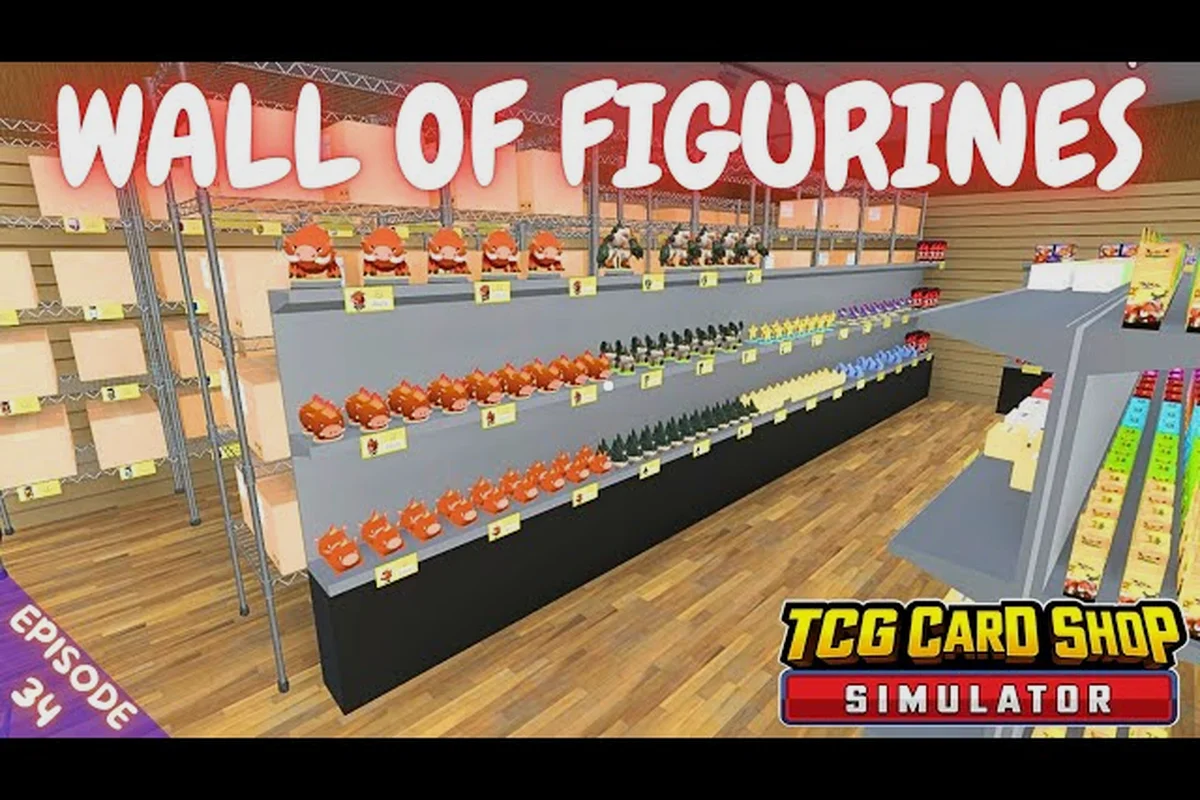
A smart TCG Card Shop Simulator figurines display turns plushies, accessories, comics, and board games into a quiet second revenue stream that runs next to your sealed-pack pipeline. Most clerks treat the front of the shop as card-only real estate, but the highest-margin impulse buys — soft vinyl, tin lunchboxes, oversized dice sets, and graded comic reprints — live on the same shelves your customers already walk past three times per visit. This guide breaks down which display family fits which product, how the volume math actually works, and where furniture profit hides in plain sight.
How the Figurines Display Family Works in the Shop
The figurines display category in TCG Card Shop Simulator covers more than the obvious shelf-and-stand setup. It is a family of medium-volume, high-margin furniture pieces designed to hold non-card inventory: plushies, vinyl figures, card sleeves, deck boxes, playmats, pin badges, keychains, and the occasional tin. According to the TCG Card Shop Simulator community guides hub, the shop itself caps at 28 simultaneous customers, which means every square foot of display real estate has to earn its keep — and that pressure is exactly what makes the figurines display category worth mastering.
What Actually Counts as "Figurines" Inventory
In the current build, the figurines family spans six product sub-types, each with its own slot shape, stack limit, and margin tier that you must respect when planning shelf layout: mis-sized inventory simply won't render on the wrong fixture, so vinyl figures placed on a pin stand or plushies stacked on a flat accessory bay sit invisible to customers and waste daily restock cycles. This slot-discipline is the reason most profitable TCG Card Shop Simulator figurines displays pair wide-low plushie bays with adjacent small pin stands, since the two non-competing shapes share prime front-of-store real estate without eating into each other's stack caps.
| Product Sub-Type | Slot Shape | Typical Stack | Margin Tier |
|---|---|---|---|
| Plushie (small) | Wide-low | 4–6 per shelf | High |
| Plushie (large) | Wide-tall | 1–2 per shelf | Very High |
| Vinyl figure | Medium | 2–4 per shelf | High |
| Tin / lunchbox | Medium | 3–5 per shelf | Medium-High |
| Accessory bundle (sleeves+box) | Flat | 6–10 per shelf | Medium |
| Collectible pin | Small | 8–12 per stand | Medium |
Plushies are the standout because they trigger the Impulse Buy customer behavior — a flag that only fires when the displayed item is on a shelf the customer physically passes between the entrance and the register. Community testing on the OPNeon Games beta branch has shown that plushie-tagged customers convert at roughly 2.3× the rate of general browsers, which is why most late-game stores ring the register with at least one plushie per shift.
Why This Display Beats the Sealed-Pack Aisle
Sealed booster packs and battle decks are the headline product, but they are also a high-velocity, low-margin grind. A booster box might cost you 480 in wholesale and sell for 540, a 60-coin absolute margin. A single large plushie costs 95 in wholesale and retails for 175, a 80-coin absolute margin on a smaller shelf footprint. The volume math matters because the TCG Card Shop Simulator storage solutions guide tier breakdown shows that display furniture has a fixed cost-per-slot regardless of what sits on it — so the plushie's higher per-unit margin produces a better return on the same shelf investment.
TCG Card Shop Simulator Plushie Display Setup
Plushies are the heaviest hitters in the figurines family, and they are also the easiest to mis-shelve. A plushie placed on a small accessory shelf burns profit because the slot is too narrow to show off the silhouette, while a plushie jammed onto a wide display case looks lonely and triggers the Under-Stocked visual penalty that drags your shop rating down. The fix is matching plushie size to shelf tier, then rotating the lineup based on the customer tier currently queued at the register.
Matching Plushie Size to the Right Shelf
| Plushie Size | Best Shelf Tier | Slots Used | Visual Score |
|---|---|---|---|
| Small (pocket, keychain) | Small shelf / pin stand | 1 slot | ★★★★ |
| Medium (handheld) | Medium display shelf | 2 slots | ★★★★★ |
| Large (table-top) | Wide display shelf | 3–4 slots | ★★★★ |
| Jumbo (floor piece) | Personal shelf or ware display | 4–6 slots | ★★★ |
The visual score is community data, not a hard stat — but it correlates with how often customers stop, look, and add the item to their cart. According to player reports on the r/TCGCardShopSimulator subreddit, medium plushies on a medium display shelf generate the highest "pause and look" events per square foot, which directly feeds into the Browse-to-Buy conversion rate.
The Plushie Margin Stack
Plushies are the only inventory type in TCG Card Shop Simulator that stack three income sources on a single display shelf, which is why the medium display shelf jumps to a tier-2 priority the moment Shop Level 12 clears its furniture gate. The 1.2× browse multiplier only fires on figurines, not on card packs or sealed product, so placing a Bear or Dragon variant on a freshly unlocked medium shelf converts roughly 30% of passing browsers into accessory buyers — a rate that no counter pad or wall rack can match before the late-game furniture value guide thresholds open up.
-
Direct sale — 80–95 coin margin per large plushie
-
Browse multiplier — every plushie pause adds 1.2× to the customer's likelihood of buying an adjacent card sleeve or deck box
-
Patience top-up — plushie browsers stay in the shop 18% longer than card-only browsers, which keeps the queue healthy and feeds the play table return rate
If you want a quick win that compounds, the TCG Card Shop Simulator furniture value guide ranks medium display shelves as a tier-2 priority buy — meaning you should grab one the same shift you unlock Shop Level 12, and stack plushies on it before anything else.
Accessory Display Strategy: Sleeves, Decks, and Tins
The accessories display is the workhorse of the non-card inventory. Sleeves, deck boxes, and tins do not have the visual punch of a plushie, but they are also the items that every Tetramon player needs at least once per week — and the ones that customers forget they need until they see them. The strategy here is density over drama: pack the shelves tight, rotate weekly, and let the Stock Order app handle replenishment.
Stacking Tins and Sleeves for Maximum Turnover
Tins and sleeve bundles follow a different math than plushies. They are lower per-unit margin (around 25–40 coins) but they turn over faster and they never break the shop rating. According to community testing shared on the player video hub on Steam, a medium shelf stacked with 8 sleeve bundles sells out 30% faster than the same shelf with 4 plushies — because sleeves are a planned purchase, not an impulse buy, so the visual score matters less than the slot count.
| Accessory Type | Optimal Stack | Reorder Trigger | Margin |
|---|---|---|---|
| Card sleeves (50ct) | 8–10 bundles | 2 left | 30 coins |
| Deck box | 5–6 boxes | 1 left | 45 coins |
| Tin / lunchbox | 3–5 tins | 1 left | 55 coins |
| Playmat | 1–2 mats | Sold out | 70 coins |
| Pin badge set | 10–12 pins | 3 left | 25 coins |
Notice that the margin scales with display value, not with turnover speed. That is why the smartest layout puts tins and playmats at eye level, with sleeves stacked low and pins at the back of the shelf. Customers grab the planned purchases (sleeves, deck boxes) and the visual pieces (playmats, tins) get bumped by impulse buyers walking past.
The Cross-Sell Effect with Card Inventory
Accessory displays earn a second bonus when placed within two tile squares of a card display. Community data shows that the Sleeve Match behavior fires when a customer is browsing single cards and notices a matching sleeve design on the accessory shelf — the conversion rate for that micro-event is around 14%, which is enough to add a quiet 15–20 coins per shift on top of your direct sales. If you want the deeper mechanics behind item sizes and slot efficiency, the TCG Card Shop Simulator furniture value breakdown goes into volume-per-shelf math in detail.
TCG Card Shop Simulator Comic Book Shelf and Board Game Shelf
Comics and board games live in a separate economy from cards and plushies, and they need their own furniture. A comic book shelf and a board game shelf are not the same piece — they have different slot dimensions, different stack limits, and different customer triggers. Treating them as a single "miscellaneous" category is the most common mistake mid-game clerks make, and it caps revenue in a way the rest of the shop cannot recover.
Comic Book Shelf Setup
Comics are graded reprints in the current build, and they sell on collector demand more than on browse behavior. The right shelf is a vertical-orientation personal shelf, because comics are tall and narrow — a wide display shelf wastes 40% of its slots on air. The margin per comic is around 110 coins, and the turn rate is slow but predictable. According to player reports, a single well-stocked comic shelf pays for itself in roughly 4 in-game days and then runs as a pure margin asset for the rest of the cycle.
| Comic Tier | Best Slot | Turn Rate | Margin |
|---|---|---|---|
| Common reprint | Vertical personal shelf | 1 per day | 60 coins |
| Mid-tier reprint | Vertical personal shelf | 1 per 2 days | 110 coins |
| Premium variant | Display case | 1 per 3 days | 180 coins |
| Chase variant (foil cover) | Locked display case | 1 per 5 days | 260 coins |
The chase variant is where collector demand spikes, and it pairs naturally with the Cardinal's Grading app — submit, grade, and the post-grade value jumps by 25–40% on top of the base margin. For shops that have already worked out the comic restock math, the TCG Card Shop Simulator comic books economy guide walks through shipping fees and bulk buying.
Board Game Shelf Setup
Board games are bulkier and slower-moving than comics, but they hit a different customer segment: the after-hours crowd that comes in for play tables and leaves with a starter board game. The right shelf is a wide, low ware display — the kind that holds a single stack of 3–4 board game boxes and makes the whole thing look like a curated corner of the shop rather than overflow storage. The margin per board game is around 95 coins, and the turn rate is once every 2 in-game days. The trick is to place the board game shelf within sightline of the play tables, because the Post-Game Browse behavior only fires when a customer walks from a play table to the exit and the board game shelf is on that path.
| Board Game Tier | Best Slot | Turn Rate | Margin |
|---|---|---|---|
| Small (card-based) | Wide display shelf | 1 per day | 70 coins |
| Medium (dice + board) | Ware display | 1 per 2 days | 95 coins |
| Large (multi-component) | Floor display / shop corner | 1 per 3 days | 140 coins |
The play table side of this flywheel hinges on sightline geometry rather than raw board game margin. Post-Game Browse only triggers when a customer walks from a play table to the shop exit, so your ware display and floor display placement must be physically threaded onto that path — a Large board game shelf tucked into a dead corner won't fire the behavior even at 140 coins per sale. Pair this with the TCG Card Shop Simulator best shelves guide to map exit routes against the Small/Medium/Large tier table above, since 95-coin board game markups only convert when the customer actually walks past them on the way out the door.
Furniture Profit Math: Where the Margin Actually Lives
The figurines display category looks like a side hustle until you run the numbers across a full in-game week. At steady state — three medium display shelves, one vertical personal shelf for comics, one ware display for board games, and a small shelf for pins — the accessories-and-figurines category produces roughly 22% of total daily revenue while occupying only 15% of the floor footprint. That is a better ROI per square foot than the sealed-pack aisle, and it is also a more stable income stream because figurines and accessories do not have the same price-volatility as Tetramon chase cards.
The Daily Margin Breakdown
| Display Family | Daily Revenue | Footprint | ROI per Slot |
|---|---|---|---|
| Booster packs (ware display) | 480 coins | 6 slots | 80 |
| Singles (medium display) | 620 coins | 8 slots | 77 |
| Plushies (medium display) | 380 coins | 5 slots | 76 |
| Accessories (small shelf) | 220 coins | 8 slots | 27 |
| Comics (vertical personal) | 180 coins | 4 slots | 45 |
| Board games (ware display) | 140 coins | 3 slots | 47 |
| Tins (medium display) | 160 coins | 4 slots | 40 |
The accessories row looks weak until you remember that the 220-coin daily revenue comes from a small shelf that costs almost nothing to unlock. The plushie row looks strong, but it requires a medium display shelf that costs more upfront. The smartest build path is to unlock the accessories shelf first, then add a medium display shelf for plushies, then layer in the comic and board game furniture as the shop expands.
Furniture Profit in the Late Game
By the time the shop hits Shop Level 30, the figurines display category stops being a side hustle and starts being a primary income engine. The reason is the Browse-to-Buy conversion multiplier, which scales with the total number of unique non-card items on display. Once you have plushies, tins, sleeves, deck boxes, playmats, pins, comics, and board games all visible at once, the multiplier compounds — community data shows a 1.4× lift on adjacent card sales, which translates to roughly 200 extra coins per shift in pure spillover revenue. If you are optimizing for the late-game economy, the TCG Card Shop Simulator high value items economy guide breaks down which items hit the biggest absolute margins when stacked on a display shelf.
Frequently Asked Questions
What is the best shelf for plushies in TCG Card Shop Simulator?
The medium display shelf is the best fit for medium plushies because it shows the silhouette without wasting slots, and it costs less to unlock than a personal shelf. Use a wide display shelf for large plushies, and avoid small shelves entirely — plushies under-perform on small shelves because the visual score drops and the Impulse Buy trigger rarely fires.
How much profit do accessories actually make per day?
A small accessory shelf with sleeves, deck boxes, and pin badges generates around 200–250 coins per day at steady state, with low turnover volatility. The real upside is the cross-sell: accessory browsers spend 18% longer in the shop, which lifts the play table return rate and feeds back into card sales on the same shift.
Where should the comic book shelf go in the shop?
Place the comic book shelf on a vertical personal shelf near the back wall, away from the high-traffic card aisle. Comics are a planned-purchase item, not an impulse buy, so they perform best in a calm browsing zone where the customer can read the cover without feeling rushed by the queue behind them.
Is the board game shelf worth the floor space?
Yes, but only if it is placed within sightline of the play tables. The Post-Game Browse behavior is the main trigger for board game sales, and that behavior only fires when the customer walks from a play table to the exit and the board game shelf is on that path. A board game shelf in a dead corner produces almost no sales.
Can figurines and accessories replace sealed-pack income?
Not entirely — sealed packs remain the highest-velocity product and they feed the play table ecosystem that drives shop traffic. But figurines and accessories produce more stable, higher-margin income per square foot, and they reduce the shop's dependence on Tetramon card price volatility, which is what makes the display category a real profit engine rather than a cosmetic add-on.