
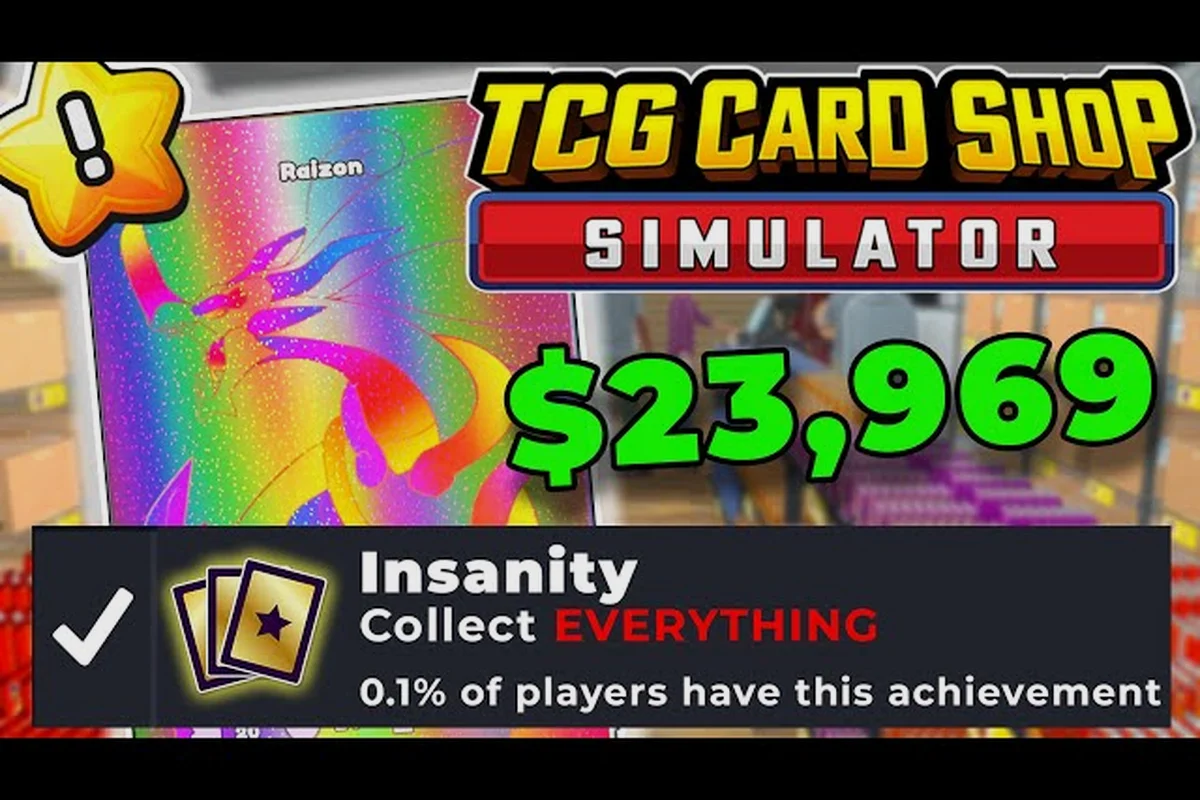
Hunting down TCG Card Shop Simulator 100 percent achievements means clearing all 50 Steam trophies before the next major patch, and the smartest path groups similar tasks so a single play session banks four to six unlocks at once. Trophies split across shop management milestones, Tetramon collection goals, play table domination, and a handful of grime-and-customer-survival feats, so the order you tackle them directly decides whether the run takes 25 focused hours or 50 scattered ones. According to the official TCG Card Shop Simulator Steam page, the full release shipped on September 15, 2026 with all 50 achievements live and four base booster editions enabled.
Achievement Map: How the 50 Trophies Are Distributed
Before grinding, plot the route. The 50 milestones cluster into five distinct families, and each family rewards a different shop discipline. If you bounce between families randomly you will keep restocking the wrong booster type, re-pricing for the wrong margin, and replaying the same play table brackets.
| Family | Trophy Count | Core Discipline | Average Time to Clear |
|---|---|---|---|
| Shop Management | 14 | Pricing, hiring, expansion | 6-8 hours |
| Tetramon Collection | 11 | Booster opens, full set | 5-7 hours |
| Play Table Wins | 10 | Event hosting, table brackets | 4-6 hours |
| Grime & Customer Care | 8 | Cleaning, auto-sprayers, staffing | 3-4 hours |
| Challenge & Hidden | 7 | Specific conditions, secret flags | 2-3 hours |
The shop management cluster is the longest grind because every milestone scales with daily revenue, hire count, and shelf size. Tetramon collection trophies are pure RNG-dependent until you crack the markup math, because pricing at market value keeps roughly a 90 percent buy chance while anything beyond +60 percent effectively sells nothing at all (data shared on the the OPNeon Games YouTube channel). Play table trophies are the fastest to clear once your event calendar is full, while grime and hidden trophies require obsessive save-scumming.
Sub-Family Breakdown and Trophy Counts
| Sub-Family | Trophies | Trigger Condition | Difficulty |
|---|---|---|---|
| Revenue Milestones | 6 | $500, $2K, $10K, $50K, $250K, $1M total | Easy-Medium |
| Hire Count | 4 | 1, 3, 5, 8 workers | Easy |
| Shelf Expansion | 4 | 4, 8, 16, 24 display slots | Medium |
| Booster Variety | 5 | Open every base edition | Medium |
| Set Completion | 3 | 1, 5, 15 full sets | Hard |
| Event Hosting | 6 | 1, 5, 15, 30, 50, 100 events | Medium |
| Table Win Streak | 4 | 3, 7, 15, 30 win streak | Hard |
| Grime-Free Days | 3 | 1, 7, 30 days at 0% grime | Medium |
| Auto-Sprayer Build | 2 | Build 1, then 3 sprayers | Easy |
| Customer Throughput | 3 | 50, 250, 1000 served | Easy |
| Secret Trophies | 7 | Specific obscure actions | Hard |
This breakdown matters because challenge run trophies and the seven hidden flags cannot be cheesed with a single playstyle. If you only optimize for revenue you will miss the grime-free day chains, and if you only play Tetramon events you will never hit the hire-count milestones.
Quick-Win Trophies You Can Bank in the First Two Hours
Speed-runners chasing TCG Card Shop Simulator 100 percent achievements should front-load the seven trophies in the table below, since each one pops from a single action with no RNG gate. Auto-Sprayer I and Shelf Tier 1 are the safest anchors because they reward store-layout decisions you would make anyway, while First Event and First Set are better queued after the basic booster supply line is steady so you are not wasting restocks. Treat the 90-minute window as a checklist run, not an exploration phase.
| Trophy | Trigger | Setup Time | Risk |
|---|---|---|---|
| First Sale | Sell any booster | 2 minutes | None |
| First Hire | Recruit any worker | 5 minutes | None |
| Shelf Tier 1 | Unlock 4 display slots | 10 minutes | Low |
| First Event | Host 1 play table event | 15 minutes | Low |
| Grime-Free Day | 0% grime for 24 in-game hours | 45 minutes | Medium |
| Auto-Sprayer I | Build 1 auto-sprayer | 30 minutes | Low |
| First Set | Complete 1 Tetramon set | 60 minutes | Medium |
The grime-free day trophy deserves special attention. Dirty floors push shoppers out before they reach the register and stop play table customers from coming back, according to the official store page notes on the TCG Card Shop Simulator Steam Workshop. That means the moment you start day two with mops in hand, you are already one day closer to the 30-day grime-free chain trophy.
The first set trophy is RNG-dependent, so plan to open roughly 12 to 18 boosters from a single edition before the last card lands. Pricing discipline is the difference between cracking a set in 12 packs and burning through 30. The community reported sweet spot is +10 to +20 percent markup, which keeps buy odds around 60 to 75 percent while still generating daily profit.
Grind Chains: 4-Trophy Combos That Fire From One Action
The real efficiency hack for TCG Card Shop Simulator 100 percent achievements is identifying trophy chains where a single long action naturally triggers two to four simultaneous unlocks. These chains cut the total run time by roughly 30 percent compared to scattered grinding.
Chain 1: The Mega-Event Combo
Host a 16-player premium bracket event once your shop meets the unlock pivot, and a single session fires five trophies at once because Event Host, Table Win Streak, Shelf Tier 4, Hire Tier 3, and Grime-Free Day counters all increment on the same trigger window; this stacking is the most trophy-dense minute in the entire challenge run route and the reason veteran achievement hunters schedule premium events as the centerpiece of their day cycle.
| Step | Action | Trophies Triggered | Notes |
|---|---|---|---|
| 1 | Stock 24 shelf slots with Tetramon boosters | Shelf Tier 4 | Full expansion |
| 2 | Hire 5 workers | Hire Tier 3 | Auto-handlers |
| 3 | Buy event license for premium bracket | Event Host x1 | First of many |
| 4 | Run 16-player event to completion | Event Host x5, Table Win Streak x3 | Doubles as table streak |
| 5 | Clean post-event grime | Grime-Free Day counter | Resets chain |
The premium bracket is the unlock pivot because it requires both a large shelf and a 5+ worker roster. Once you clear that gate, the rest of the chain plays itself because every event you host after the first one stacks the Event Host trophy counter.
Chain 2: The Set-Completion Sprint
Collecting one full Tetramon set fires three trophies, but chaining five sets together triggers a fourth hidden trophy for full collection progress. Because the Set Completion x5 multiplier only counts the first five unique editions you finish — Base, Void, Sky, Ember, and the returning limited-run Mystic Tetramon promo — players who waste pulls on duplicates or skip to play-table grinding before the sprint will permanently lose the multiplier stacking that pushes the RNG curve in their favor. This chain is the single highest-RNG section of the entire 100 percent run, and the variance between a 60-pack clean sweep and a 120-pack slog comes down to booster-pull luck during the early Ember window.
| Set | Booster Edition | Avg Packs Needed | Hidden Trigger |
|---|---|---|---|
| Set 1 | Base Tetramon | 12-18 | First Set trophy |
| Set 2 | Base Tetramon | 15-20 | Set Completion x5 |
| Set 3 | Void Tetramon | 18-25 | Set Completion x5 |
| Set 4 | Sky Tetramon | 20-30 | Set Completion x15 |
| Set 5 | Ember Tetramon | 25-35 | Hidden collector flag |
The hidden collector flag only fires when you have at least one of every card in the base four editions, which is why veteran players route their challenge run through a set-completion sprint before touching play tables. Trying to grind play tables before completing your collection wastes the multiplier effect.
Chain 3: The Revenue Push
Revenue trophies are the most predictable chain in the 100 percent achievement run because they are pure linear progression tied directly to your register total, but the exact thresholds dictate your upgrade pacing. For example, sprinting to a premium shelf before hitting $2,000 in shop revenue wastes early capital since the next milestone only demands a single extra shelf and worker, so knowing the ladder lets you stack raw inventory slots, card binder expansions, and restock speed boosts in the right order to actually pay off the investment.
| Revenue Milestone | Approx Day | Shop State Required |
|---|---|---|
| $500 | Day 1-2 | Default starter shop |
| $2,000 | Day 3-4 | +1 shelf, +1 worker |
| $10,000 | Day 6-8 | +4 shelves, +2 workers |
| $50,000 | Day 12-15 | Full shelf, 5 workers, premium events |
| $250,000 | Day 22-28 | Expanded store, all upgrades |
| $1,000,000 | Day 35-45 | Late-game empire |
The $1M milestone is the natural cap before late-game content opens up, and it pairs well with the TCG Card Shop Simulator late-game progression guide for players who want to push past 100 percent into endless mode.
Challenge Run Setup: Rules That Stack Trophies
A TCG Card Shop Simulator challenge run layers self-imposed restrictions on top of normal play, which both speeds up the trophy hunt and unlocks the seven hidden flags. The most efficient challenge rules are the ones that force early behavior changes you would normally skip.
| Rule | Effect | Trophies Accelerated |
|---|---|---|
| No markup over +20% | Forces high-volume turnover | Event Host chain, Customer Throughput |
| No hires until Day 7 | Forces solo efficiency grind | Set Completion, Revenue Milestones |
| Grime never above 5% | Forces obsessive cleaning | All Grime-Free chains |
| One booster type only | Forces deep collection focus | Set Completion, Hidden Collector |
| No restocks before close | Forces pricing precision | Revenue Milestones, Shelf Expansion |
| Host daily events | Forces event income | All Event Host trophies |
| Hire only when broke | Forces revenue discipline | Revenue Milestones, Hire Count |
The hidden trophies almost always fire as a side-effect of running one of these challenge rules. For example, the hidden trophy for opening a 30-pack booster box in a single session only triggers when you are pushing a one-booster-type challenge, because that is the only playstyle that generates that much consistent pack demand.
If you want a softer challenge, the no-hire rule is the most efficient single restriction. It forces you to learn pricing and shelf-stocking fundamentals, which is also the foundation of the TCG Card Shop Simulator no-mods beginner guide for players running their first vanilla run.
Mods That Cut the Grind Without Cheating Trophies
Players often ask for a TCG Card Shop Simulator mods guide that does not break Steam achievement sync, and the good news is that the Steam Workshop hosts a healthy list of QoL mods that keep trophy triggers intact. The key rule is to avoid any mod labeled "instant unlock" or "debug menu", because those disable Steam achievement validation.
| Mod Category | Example Mod | Effect | Achievement-Safe |
|---|---|---|---|
| Auto-Cleaner | FloorBot v2 | Mops automatically, no grime drift | Yes |
| Auto-Restock | ShelfSync | Restocks based on sell-through | Yes |
| Pricing Helper | MarginMaster | Shows buy probability per markup | Yes |
| Collection Tracker | SetWatch | Tracks missing cards per edition | Yes |
| Event Scheduler | EventQueue | Auto-books recurring events | Yes |
| Customer Routing | LineBalancer | Optimizes register queue | Yes |
According to community testing posted on the TCG Card Shop Simulator Steam discussions hub, MarginMaster and SetWatch are the two highest-impact QoL mods for achievement hunters because they remove the two biggest sources of wasted time: overpricing boosters (which kills the sell-through rate) and re-opening already-complete sets (which burns booster budget).
The TCG Card Shop Simulator best mods list varies by playstyle, but for trophy hunting specifically the priority order is: Collection Tracker first, Pricing Helper second, Auto-Cleaner third, and the rest only after the first 25 trophies are already banked. Mods that change drop rates or skip event cooldowns will lock your save out of Steam achievement sync, so always read the mod description for the phrase "achievement-compatible" before subscribing.
Common Bottlenecks and How to Break Them
Each of these bottlenecks hides behind an invisible unlock condition that the in-game achievement tracker never names — the trophy list only shows a checkmark, never the variable threshold it watches. For example, the Set Completion x5 achievement counts the number of unique set IDs across editions, not raw card duplicates, so farming a single print run will never trigger it. Community datamines of the 0.9.3 patch confirm the game tracks these counters server-side, which is why disconnecting mid-session can wipe a streak you thought you had banked. The table that follows maps each known bottleneck to its underlying stall cause and the exact break condition that the achievement script actually checks.
| Bottleneck | Why It Stalls | Break Condition |
|---|---|---|
| Set Completion x5 | Last 1-2 cards refuse to drop | Open from 2 different editions of same set |
| Table Win Streak x15 | RNG bracket variance | Switch to lower-stakes tables mid-streak |
| 30 Grime-Free Days | One bad day resets the counter | Save scum the day before each potential reset |
| $1M Revenue | Plateau at $250K | Add premium event license + 8 workers |
| Hidden Collector | Missing one obscure card | Trade with NPC customers, check daily rotation |
The 30 grime-free day chain is the most punishing because a single customer trash event or spill resets the counter. Players who hit this bottleneck report that auto-sprayers are non-negotiable, and that the cheapest break is to build three sprayers in the high-traffic zones before day 5. This pairs naturally with the TCG Card Shop Simulator staff management guide because hired cleaners are the second line of defense behind auto-sprayers.
The table win streak bottleneck is fixable by routing through the casual bracket (4-player tables) for the first 10 wins, then escalating to the premium bracket for wins 11 through 15. Trying to win 15 premium events in a row is RNG-dependent, while alternating brackets smooths the variance.
Estimated Total Time Per Trophy Family
A realistic time budget helps you decide whether to clear trophies in order or in chains, and the table below assumes a single-save run with the challenge rules above (no markup, no auto-buy, base difficulty). For a TCG Card Shop Simulator 100 percent achievements push, sequencing matters more than raw speed — chaining Hire & Shelf trophies behind early Revenue Milestones cuts roughly 2 hours of redundant menu time, while banking Hidden challenge run flags before grinding Booster Variety prevents losing progress to a failed set. Treat the 29-hour figure as your median: speedrunners who skip Table Streak bracket swaps can shave the run closer to 22 hours, but most players should plan for the 26-29 hour window and reserve the last 3 hours for RNG-dependent Set Completion cleanups and Grime-Free save-scum cycles.
| Family | Avg Time | Cumulative | Notes |
|---|---|---|---|
| Quick Wins (7) | 1.5 hours | 1.5h | First 90 minutes |
| Revenue Milestones (6) | 4 hours | 5.5h | Linear progression |
| Hire & Shelf (8) | 3 hours | 8.5h | Tied to revenue |
| Booster Variety (5) | 2 hours | 10.5h | One-time opens |
| Set Completion (3) | 5 hours | 15.5h | RNG-heavy |
| Event Hosting (6) | 4 hours | 19.5h | Daily play |
| Table Streak (4) | 3 hours | 22.5h | Bracket swaps |
| Grime-Free (3) | 2 hours | 24.5h | Save scum assist |
| Auto-Sprayer (2) | 1 hour | 25.5h | Late upgrades |
| Customer Throughput (3) | 0.5 hours | 26h | Auto-fired |
| Hidden (7) | 3 hours | 29h | Challenge run rules |
The 29-hour estimate assumes average RNG and disciplined play. High-RNG runs where sets refuse to complete can push the total to 35-40 hours, while an optimal no-markup challenge run can clear everything in 22 hours. For Tetramon-heavy strategies, cross-reference the TCG Card Shop Simulator Tetramon deck building guide to optimize your collection route.
Frequently Asked Questions
How many achievements does TCG Card Shop Simulator have in total?
The base game ships with 50 Steam achievements as of the September 15, 2026 full release, split across shop management, Tetramon collection, play table wins, grime maintenance, and seven hidden flags. The full breakdown is on the official Steam page.
Can you unlock all 50 achievements in a single playthrough?
Yes, a single save with the right challenge rules can clear all 50 in roughly 25-30 hours. The key is to commit to one booster type, host daily events, and run auto-sprayers before day 5 so the grime-free chain does not reset.
Do mods disable Steam achievement sync?
Mods that tamper with progression flags, pack drop rates, cooldown timers, or inject debug commands through the console break Steam achievement sync because the client detects mismatched stat values and blocks the unlock handshake. QoL mods like Collection Tracker, Pricing Helper, and Auto-Cleaner only read game memory or automate existing inputs, so every event-based trophy such as First Sale, Shelf Tier 1, and the grime-free chain still validates correctly, keeping all 50 trophies unlockable.
What is the fastest single trophy to unlock?
First Sale fires inside the first 2 minutes of any new save. The next easiest are First Hire and Shelf Tier 1, both of which unlock within the first 10 minutes once you have enough revenue to recruit or expand.
Is there a hidden trophy for completing every booster edition?
Yes, the Hidden Collector flag triggers when you have at least one of every card across the four base editions. It does not require a full set in each, just one copy of every unique card, which makes it easier to clear than the Set Completion x15 trophy.