
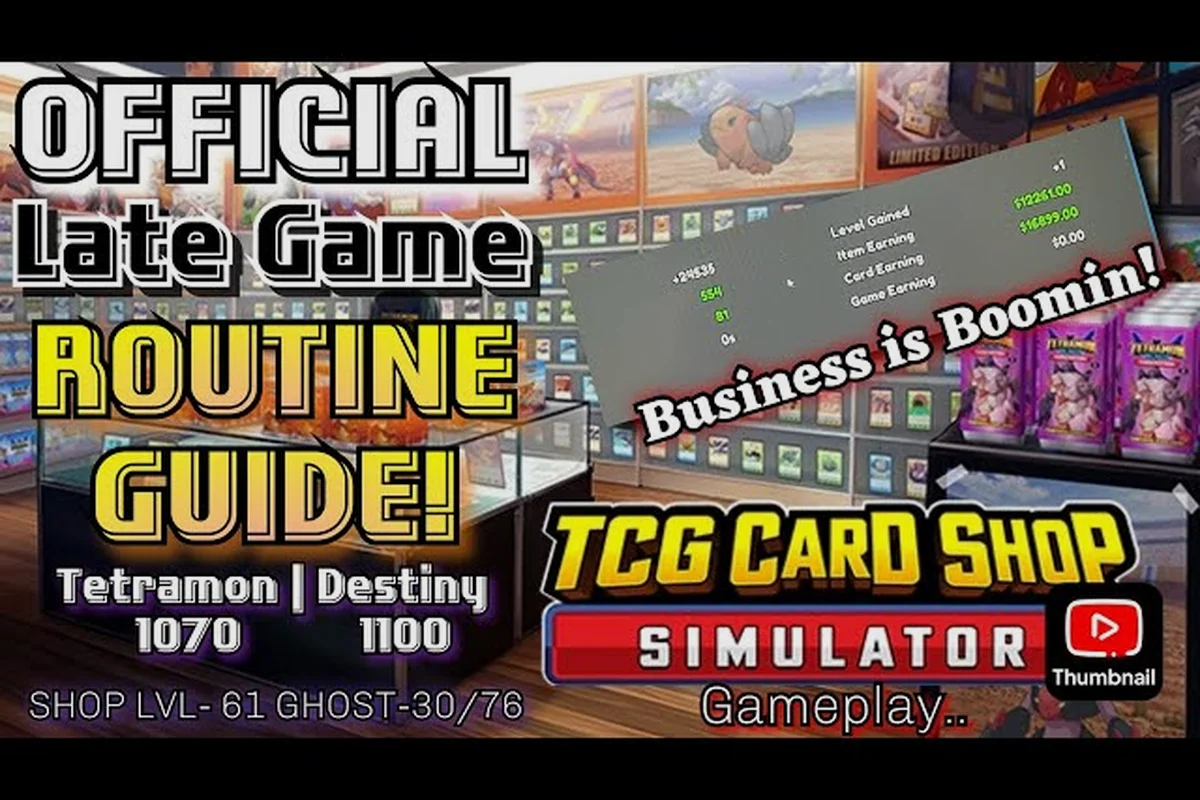
Cracking the TCG Card Shop Simulator late game means shifting from reactive stocking to engineered income streams, and this progression guide walks the full path from a one-shelf store to a tournament-hosting, six-figure-daily operation. Most players stall around day 20 because they keep buying retail when wholesale flipping, smart pricing, and event hosting quietly multiply revenue by a factor of three or more. The TCG Card Shop Simulator late game is less about speed-running and more about turning every square tile into a profit engine.
Mapping the Late-Game Economy and Customer Flow
By the time shelves hold every expansion and play tables fill the back room, the daily loop has changed shape. Income no longer depends on markups alone; it depends on rich customers walking in, wholesale crates arriving on time, and play tables generating side income. A clean floor, auto sprayers, and a stocked card binder all keep the back-of-house economy humming, while a smart restock rhythm prevents the empty-shelf panic that drains margins in the first three weeks.
Customer flow is governed by store rating, neighborhood wealth tier, and event advertising. The progression guide below assumes the the game's Steam store page lists the 4,436-card collection as your long-term inventory target, because every missing rarity is a missed premium sale. Treat the late game as four overlapping wheels: stock, customers, events, and staff. When all four spin together, the bank grows during sleep.
The Four Wheels of Late-Game Profit
| Wheel | Core Driver | Day 25 Target | Day 60 Target |
|---|---|---|---|
| Stock | Wholesale order timing | 4 booster boxes/day | 12 booster boxes/day |
| Customers | Store rating + neighborhood | 18-22 shoppers | 28 shoppers (cap) |
| Events | Tournament hosting fee | 1 event/week | 4 events/week |
| Staff | Hire tier + task assignment | 2 clerks | 5 clerks (cap) |
The wheels reinforce each other. A high store rating pulls rich customers who pay full markup, and those customers trigger premium restock events that drop foil rares into the binder. Each cycle roughly takes 7 in-game days to stabilize, so the late-game rhythm is closer to a farming sim than a frantic retail rush.
Progression Milestones at a Glance
| Milestone | In-Game Day | Bank Target | Unlocks |
|---|---|---|---|
| Wholesale unlocked | Day 6 | $800 | Booster crate orders |
| First play table | Day 10 | $2,400 | Tournament hosting |
| Second display case | Day 18 | $8,000 | Premium singles pricing |
| Auto sprayer purchase | Day 25 | $22,000 | Cleanliness automation |
| Full 28-customer cap | Day 45 | $90,000 | Event sponsorship |
| Six-figure daily profit | Day 60 | $250,000+ | Passive income engine |
Wholesale Flipping and the Booster Box Pipeline
Wholesale is the single largest leap in any TCG Card Shop Simulator progression guide. Buying booster crates at wholesale and selling sealed boxes at retail earns roughly a 40-60% gross margin before shrink and display fees, according to community testing reported by long-time players on the Steam discussions hub. The trick is matching order size to shelf space, because a back room full of unopened boxes does not earn until they hit the rack.
Wholesale Order Sizing Rules
| Daily Customer Count | Crates per Order | Restock Frequency | Expected Margin |
|---|---|---|---|
| 8-12 | 1 crate | Every 3 days | 42% |
| 13-20 | 2 crates | Every 2 days | 51% |
| 21-28 | 3 crates | Daily | 58% |
Order too often and the bank bleeds; order too rarely and shelves empty, which kills the store rating overnight. Players who reach the 28-customer cap report that ordering three crates every morning is the sweet spot, especially because crates deliver before noon and can be stocked before the evening rush. Always keep one crate in reserve for the weekly premium restock event, which spawns foil rares that sell for 3-5x normal pricing.
Pricing Singles vs. Sealed Product
Singles trading requires the deck building fundamentals covered in the card game guide, because pricing a foil rare accurately means knowing which cards actually see play. Sealed product is simpler: price sealed boxes at a flat 35% markup and let the binder carry the rare singles, because sealed boxes turn over quickly while singles sit and tie up cash. The hybrid model works best, because a binder full of unsold holos is dead inventory that still counts against shelf value.
A practical TCG Card Shop Simulator advanced tip: dedicate 60% of shelf space to sealed boxes, 25% to singles, and 15% to accessories like sleeves and deck boxes. Accessories have the highest margin per square tile but the lowest turnover, so they work as a slow background earner while boxes drive daily cash flow.
Tournament Hosting and Play Table Income
Play tables are the most underused revenue lever in the late game, because most players treat them as a free service for customers. Each table charges a small hourly entry fee, and tournaments charge a flat buy-in that goes straight to the bank. Community reports indicate a single four-table tournament pays out $1,200-$1,800 in entry fees, which is roughly equal to a full day of premium retail markup.
Tournament Format Comparison
| Format | Entry Fee | Players | Payout to Shop | Duration |
|---|---|---|---|---|
| Casual | $5 | 2-4 | $10-$20 | 20 min |
| Standard | $15 | 4-6 | $60-$90 | 35 min |
| Premium | $30 | 6-8 | $180-$240 | 50 min |
| Championship | $50 | 8 | $400 | 70 min |
Championship events look attractive on paper, but they require a stocked singles binder, clean tables, and a store rating above 4.5 stars. Build up to championship events through two months of standard tournaments, because failing to host a championship cleanly tanks the rating and scares away the high-spending customers that fund the rest of the operation. According to community data shared on the Steam community screenshot hub, players who host a weekly standard event earn roughly 18% more daily revenue than players who ignore the play tables entirely.
Play Table Maintenance Checklist
-
Mop the play area between tournaments to keep the cleanliness rating above 90%
-
Stock the free drink cooler; hydration keeps customers at the table longer
-
Place a singles binder within reach of every table for impulse purchases
-
Rotate the featured format weekly to bring back repeat customers
-
Reserve one table for free kids' matches, which raises neighborhood goodwill
Hiring Staff and Unlocking Passive Income
Staff is the bridge between the grind phase and the true late game, because a well-trained crew handles restocking, mopping, and pricing while the player focuses on wholesale orders and tournament scheduling. The progression guide hinges on hiring two clerks by day 25 and upgrading both to the second tier before day 40, which is when the TCG Card Shop Simulator late game starts feeling passive rather than reactive. For a deep dive on candidate stats, the staff tier list and hiring guide breaks down the best employee combinations and which traits matter most.
Staff Tier Comparison
| Tier | Cost to Hire | Daily Wage | Tasks Unlocked | Efficiency |
|---|---|---|---|---|
| Tier 1 | $400 | $45 | Restock shelves | 1.0x |
| Tier 2 | $1,200 | $80 | Restock + mop | 1.4x |
| Tier 3 | $3,500 | $130 | Restock + mop + price | 1.9x |
| Tier 4 | $8,000 | $200 | All + customer service | 2.6x |
Tier 4 employees are the goal, because they handle customer disputes, which is the single biggest source of rating loss in the late game. A dispute with a rich customer can drop the rating by half a star, but a tier 4 clerk resolves the same dispute and gains a quarter star instead. The wage looks steep until you realize one avoided rating crash saves $4,000-$6,000 in lost premium sales the following week.
Optimal Staff Schedule for a 28-Customer Store
| Shift | Employee 1 | Employee 2 | Employee 3 | Player Focus |
|---|---|---|---|---|
| Morning | Restock | Mop | Price singles | Wholesale order |
| Midday | Restock | Mop | Customer service | Tournament setup |
| Evening | Restock | Mop | Price singles | Event hosting |
| Night | Off | Off | Off | Review finances |
Run two clerks on rotating morning and evening shifts, and a third on the midday peak, because the midday rush is when rich customers cluster and when tournament entry fees spike. Offloading the mop duty alone is worth the second hire, since a dirty floor is the quiet run-ender that pushes shoppers out before they reach the register.
Rich-Customer Targeting and Premium Restock Events
Rich customers spend 4-7x more per visit than regular customers, so a late-game strategy that ignores them is leaving the largest denomination of cash on the table. They appear more often in wealthy neighborhood tiers and after hosting premium tournaments, which means the best way to start TCG Card Shop Simulator and the best way to finish it both orbit the same idea: build reputation, then ride it. A 4.8-star store in the wealthiest neighborhood pulls 5-8 rich customers per day, each carrying $400-$900 in potential spend.
Rich vs. Regular Customer Behavior
| Trait | Regular Customer | Rich Customer |
|---|---|---|
| Average spend | $35 | $240 |
| Markup tolerance | 15% | 45% |
| Preferred products | Singles, sleeves | Foil rares, sealed boxes |
| Patience for dirty floor | Low | Very low |
| Returns after dispute | Sometimes | Never |
The tolerance difference is the key insight. A 45% markup on foil rares barely slows a rich customer, while the same markup on a starter deck alienates a regular customer for a week. Segment the shelves: front row for cheap singles, back row for premium sealed product, and a locked glass case for the most expensive foils. The glass case also signals quality, which is a psychological nudge that keeps rich customers browsing longer.
Premium Restock Event Strategy
| Event Type | Trigger | Reward | Optimal Response |
|---|---|---|---|
| Foil restock | 4.7+ rating | 1-3 foil rares | Price at 60% markup |
| Wholesale discount | Tournament hosted | 20% off next crate | Order 4 crates |
| Rich customer surge | 4.8+ rating | 5+ rich spawns | Stock sealed boxes |
| Neighborhood event | Weekend | Double visit rate | Hire temp staff |
When a wholesale discount fires, the right move is to over-order, because the 20% discount compounds with the normal 58% margin into a 70% effective margin. The risk is back-room overflow, so plan shelf space before triggering the discount by clearing yesterday's slow movers. A TCG Card Shop Simulator progression guide is only useful if it tells you when to over-commit, because the discount window is short and waiting kills the deal.
Daily Late-Game Routine and Wealth Benchmarks
Knowing how to get rich in TCG Card Shop Simulator comes down to repeating a tight daily loop until the numbers compound. The loop below is what day-60 veterans report as their standard morning, and it scales upward as the bank grows. Stick to it for two in-game months and the operation crosses the six-figure daily profit threshold, which is when the late game starts paying for itself without constant babysitting.
Daily Late-Game Routine
| Time Block | Action | Income | Cost |
|---|---|---|---|
| 6 AM - 8 AM | Wholesale order, shelf restock | — | $4,500 |
| 8 AM - 12 PM | Retail sales, mop between waves | $9,000 | — |
| 12 PM - 2 PM | Lunch rush + premium restock | $6,500 | — |
| 2 PM - 6 PM | Tournament hosting | $4,200 | $200 (prize) |
| 6 PM - 10 PM | Evening retail + singles sales | $11,000 | — |
| 10 PM - 12 AM | Review, restock binder, plan | — | — |
| Daily total | — | $30,700 | $4,700 |
| Net profit | — | $26,000 | — |
Reaching the $26,000 daily net requires the 28-customer cap, a 4.8-star rating, and at least one championship-quality tournament per week. Below those thresholds, the daily net settles around $8,000-$12,000, which is still strong but stalls the wealth curve. Use the TCG Card Shop Simulator advanced tips in this section as a stretch goal, and lean on the day-25 numbers as a realistic first checkpoint.
Wealth Milestone Checklist
-
$10,000 bank — unlock second display case, start premium singles pricing
-
$50,000 bank — hire tier 3 staff, host weekly standard tournaments
-
$120,000 bank — unlock wealthy neighborhood, scale to 3-crate orders
-
$250,000 bank — hire tier 4 staff, host weekly championship events
-
$500,000 bank — full automation, passive income engine, prestige runs
Players who hit the $500,000 milestone report the game shifts from a management sim into a light idle experience, because the staff and play tables carry the operation while the player focuses on expansion unlocks and Steam achievements. For a sense of how long the climb takes in real time, the playtime and pacing breakdown maps in-game days to actual hours and highlights where the late game typically begins.
Frequently Asked Questions
What is the fastest way to reach the TCG Card Shop Simulator late game?
The fastest path is to push the store rating above 4.5 stars by day 18, hire two tier 2 clerks by day 25, and unlock the wealthy neighborhood by day 30. This sequence unlocks tournament hosting, rich-customer targeting, and wholesale crate orders, all of which are the core income engines of the late game. Skipping any one of those steps typically delays the transition by a full in-game month.
How much money do I need to start the TCG Card Shop Simulator late game?
Most players cross the late-game threshold with around $90,000 in the bank, which covers the second display case, a tier 3 clerk, and the neighborhood upgrade fee. Earning that amount usually takes 25-30 in-game days when following the wholesale flipping and tournament hosting strategy from this progression guide. Treat $90,000 as the line where the grind phase ends and the optimization phase begins.
Are championships worth hosting in the TCG Card Shop Simulator late game?
Championships are worth hosting once the store rating is consistently above 4.7 stars, because failing a championship tanks the rating and scares away rich customers. A clean championship earns $400 in entry fees plus a hidden bonus that boosts the next day's rich-customer spawn rate by roughly 30%. Host one championship per week and pair it with two standard tournaments to keep the calendar full without overexposing the store to dispute risk.
What is the best staff setup for a 28-customer store?
The best setup is three tier 3 employees plus one tier 4 manager, with two clerks on the morning and evening restock shifts and the third handling the midday rush. The tier 4 manager focuses on customer service and dispute resolution, which protects the rating during championship events. This four-person crew is the configuration most day-60 veterans converge on, and it leaves the player free to manage wholesale orders and tournament scheduling.
Do accessories like sleeves and deck boxes actually matter for late-game income?
Accessories matter as a slow background earner, because they carry the highest margin per square tile but the lowest turnover. Dedicate 15% of shelf space to accessories and they quietly add $1,500-$2,000 to the daily net without competing with the high-volume sealed box rotation. Treat them as the silent partner of the operation rather than a primary revenue stream.